The Second Cylon War began with a massive surprise strike against the Colonies by the Cylons. Nearly all Colonies were attacked at the same time, a quarter of the fleet was destroyed in the early hours and civilian losses ran into the tens of millions.
Many Battlestars found their systems disabled during the fighting, seemingly remotely switched off by the Cylons using a backdoor in the Command Navigation Program. This vulnerability meant the loss of hundreds of ships in the initial engagement. Only a handful of Colonial ships had not been upgraded with the CNP, while others were saved by a faulty update, which by sheer coincidence prevented the Cylons from accessing the targeted ships, though many were lost to sleeper viruses and logic bombs later on.
For three days the Colonial fleet fought for the survival of Humanity. By which time nearly half the Fleet was lost, but the Cylons withdrew with substantial losses and the Colonies struggled to regroup.
One of the first casualties of the war was President Adar. Many other cabinet members were killed or severely injured, leaving the secretary of the Treasury as the new President.
Within days reserves were called up and tens of thousands of volunteers joined up with the Fleet, reserve ships were hastily rearmed and refurbished and long range patrols were sent deep into Cylon space.
The fact that the Cylons had been able to attack all Colonies simultaneously, meant that they had an increased jump range and that no system was safe from attack. Extending the safe zone would be the primary concern for the Fleet in order to buy the extra vital minutes to prepare defences in case of another attack.
Meanwhile the Fleet prepared a strike force that would look for the Cylon homeworld and annihilate the Cylon presence once and for all.
Sunday, August 22, 2010

Sunday, August 8, 2010
Battlestar Profile 019 : BSG 175 Pandemonium Class Battlestar Pandemonium
Designed at the height of the Cylon War the Titan Class Battlestars are the largest and most powerful ships in the Colonial Fleet. Completed after the Armistice they have often been criticized for being too big and costly, lingering fear of renewed hostilities with the Cylons saved them from the scrapheap, but as time moves on, rising costs and budget cuts are increasingly threatening the Titans.
The immediate post-war trend of increased ship size was reversed nearly three decades ago with a return to Battlestars of a more moderate size, incorporating advanced technology making them just as potent as their larger counterparts, it seemed it would only be a matter of time before the larger vessels would be a thing of the past, until the introduction of the Nova Class. Designed as Fleet command ships, the Nova Class, while not as massive as the Titans, it is significantly larger than the Mercury Class, long considered to be the modern mainstay of the Colonial Fleet.
With an eye on the impending demise of the Titans and the need to replace their massive firepower, a new Novastar, the Pandemonium was recently launched for trials. This highly unusual Battlestar mounts three separate flight pods, allowing the Pandemonium to handle 16 Squadrons of Vipers with room to spare and up to 20+ in wartime conditions.
Another unusual feature is the lack of turrets. The Pandemonium relies on its fighters and massive forward battery to deal with any threat, backed up by an impressive CWIS array. The theory being that the forward battery allows the Pandemonium to stand off enemy vessels while offering a lower target profile. A number of turrets are mounted in the flight pods.
Despite being nearly as long as a Titan, the Pandemonium is much lighter and requires a much smaller crew of around 3500, comparable to the original crew complement of an Atlantia Class Battlestar.
Fleet headquarters are reluctant to give this class the go-ahead, hoping to retain the Titans as long as possible, but they are facing increased political pressure to yield to the Pandemonium.
The Pandemonium has performed well on its initial trial runs. The flight pod array has been described as unusual, but elegant, giving the Pandemonium a fast, sleek and menacing appearance. There are some concerns that the relatively limited number of turrets might put the Pandemonium at a disadvantage should enemy ships attack from the sides and rear. A change in armament is being studied and could be implemented on the next vessel, possibly leading to a completely new class and leaving the Pandemonium as the sole example of her class.
Commander : Commander Warren Langley
XO : Colonel Jordan Vallenor
CAG : Captain Sam Tipper
Complement : 16-20 Viper Squadrons and up to 50 Raptors
Armament : 5 Deathbolt XXX Forward batteries, 3 Starfire rapid fire forward batteries, 2 Broadsword heavy forward batteries. 16 double turrets, 980 Derlam Shield II heavy quad CWIS, 1240 Derlam Shield III heavy double CWIS. 28 missile bays.
Supportstar Profile 20 : Odyssey Class Tanker Almaron
Based on the flexible Archeon cargo transport the Odyssey class was a modified version capable of carrying a detachable Tylium fuel tank. This allowed a much faster turnover rate as the fuel tanks could be filled up and loaded onto the Odyssey. Only five tankers were made for use during the Cylon War and were primarily used to refuel ships equipped with Vulcanus engines, which required a specially refined Tylium fuel. Since less than a quarter of ships in the fleet had such engines, the Odyssey, alongside other tankers were quite adequate in serving their needs.
Well armed as a tanker, it carried ten single barrel barbettes in the forward section and over a 120 CWIS batteries to defend against enemy fighters. Additionally the Odyssey had a small flight pod on the Starboard side holding several service craft and small tankers in addition to a squadron of Python fighters for added defence.
Though often hunted down by Colon forces the Odyssey suffered only a single combat loss. Of the four surviving vessels , three were scrapped after the war and one remains in the reserve, should older Vulcanus-equipped ships be sent back to active duty.
The Almaron, named for a region on Caprica, famous for its ancient tar pits and oil reserves was actively used to combat the drought on Aerilon shortly after the Cylon war and saving millions of lives. Converted to carry water the ship made 25 runs, delivering millions of JP's of water from Aquaria. The effort involved people from all over the Colonies and is considered one of the major events bringing the Colonies closer together.
Sunday, July 25, 2010
Colonial Heavy Liner
Based on the older and highly popular Colonial Clipper Liner, the Heavy Liner is a common sight across the Colonies. The second generation multi-deck widebody allows it to transport large numbers of passengers cheaply and effectively.
A versatile design, the Heavy Liner can be found in a nearly unlimited range of configurations, ranging from hyper-luxurious private yachts and low-cost carriers to military transports and science exploration vessels. Primarily designed for rapid passenger transit (usually under 24 hours) between planets, the Heavy Liner is much smaller than most passenger cruisers, and usually lacks private cabins though sleeping seating is usually provided.
Though referred to as a Liner, this vessel is technically an FTL passenger transport and the designation Heavy comes from the fact that it can land on a Battlestar's flight pods and being the largest craft capable of doing so rather than dock with it, as would be the case with larger vessels .

The multi-deck configuration allows for a maximum range of options between passenger and cargo transport. The private yachts often include swimming pools, pyramid courts and even zero-g rooms. Many can dock with small craft such as shuttles to transport passengers and goods.
More than seven thousand Heavy Liners have been built to this day, making it one of the most profitable ventures by Colonial Shipyards and making it one of the most familiar spacecraft commonly seen.
The Military version includes improved wireless and electronics and are most commonly used as personnel transports and to transfer light cargo. Though not designed for combat use, a number have been equipped with CWIS turrets for defence against enemy craft. Because it can make planetfall, the Liner is also used by the Colonial Marines as a transorbital transport capable of delivering 250 troops and up to six light vehicles. The gunship configuration, carrying an impressive arsenal of guns in its cargo bays and capable of laying down a withering barrage of firepower against ground targets. The current version mounts 12 x 23mm rotary cannons, 6 x 40mm cannons and 4 x 105mm cannons and are capable of concentrating this firepower into an area the size of a Pyramid field. Because these weapons use ordinary propellant they cannot be used in space.
Originally the Colonial Government had a fleet of eight Heavy Liners to be used by the President and Cabinet Members, in recent years all but two have been retired by President Adar to distance himself from his predecessor's spendthrift. Chartered Liners are used when the need arises. The Liner carrying the President is always referred to as Colonial One even as a charter. The remaining Liners currently in service include extensive cargo and passenger space in addition to offices, sleeping quarters and a fully staffed kitchen.
Sunday, June 6, 2010
Colonial Raptor
Designed shortly before the Cylon War the Raptor is one of the most enduring designs in the entire Colonial Fleet. Extremely rugged it has consistently outperformed all designs meant to replace it over the years and has been upgraded to incorporate the latest technology.
The original Raptor was designed as a light scout and transport. To this end it is equipped with sophisticated DRADIS and has its own short-ranged FTL drive. Over the years the Raptor began to replace the ageing Firehawk and Hydra Electronic Airborne Warning (AEW) craft, incorporating the DRADIS antenna into the Raptor's lower wing, making it much less conspicuous.

The versatility and ruggedness of the Raptor means it has become invaluable to Colonial Fleet operations and its roles have been expanded to include the following tasks :
- Scouting and IFF Advanced Warning operations for Viper squadrons
- ECM and electronics warfare platform
- Missile carrier and gunship
- Search and Rescue and Medevac missions
- Light Shuttle and Combat Operations Craft
Though slow and vulnerable compared to the swift Viper, the Raptor has many weapon hardpoints, mounting missiles, rockets, bombs and guns, making it into an effective light gunship and missile carrier.
An lengthened version with a larger cargo bay is used exclusively by the Colonial Marines as a combat transport and adds extra armour and ballistic lining to protect the crew and features a pair of remote controlled door guns.
Several craft were developed to replace the Raptor, but none could match the versatility and combat readiness percentage of the Raptor. The proposed Advanced Operations Craft is the latest attempt to produce a craft that will completely replace the Raptor. The AOC, in addition to multiple internal and external hardpoints will feature a modular cargo bay, allowing the craft to simply swap one modular element for another and increase versatility, while allowing more specialisation with each module than was previously possible on the Raptor.
Should the AOC fail, a rumored Super-Raptor has been hinted at, slightly larger and partially based on the Marine version, this Raptor could extend the five-decade lifespan into a century or more.
Scorpia Fleet Shipyards
One of the major hubs of the Colonial Fleet is Scorpia. The vast orbiting yards account for nearly half the Fleet's manufacturing and berthing capacity. The original yards were built nearly a century ago as part of Scorpia's military expansion thanks to the mineral rich half-ring that orbits the planet, the fragmented remains of a moon. Originally hidden inside the debris, the Shipyards allowed the Scorpians to secretly build a fleet in her bid for independence from Leonis.

Once Scorpia gained her independence the facilities were quickly expanded and became a major deterrent to Leonese ambitions to recapture this Colony. After the signing of the Articles of Colonisation and the outbreak of the Cylon War, the shipyards were incorporated into the Colonial Fleet and became a major staging area for the Fleet. Attacked several times by the Cylons the Shipyards were either hidden inside moon fragments or sufficiently scattered that they could not easily be knocked out.
After the War many Colonial shipyards were closed and consolidated with others leading to Scorpia becoming one of the key bases. This decision was mostly economic and many in the Service protested that the Shipyards would be a prime target for Cylon attacks and could potentially cripple the Fleet if they were able to launch a surprise attack, but after many years of heated discussion Fleet Heaquarters asserted there would be sufficient time to respond to an attack and that the Shipyards would not require additional defences or special measures. Recently, an investigative reporter team from Leonis uncovered a possible corruption scandal involving Scorpia, but these allegations have so far been denied by the current administration. This new development puts further strain on the already unpopular Adar.
The Shipyards have been expanded and include the largest docks in the Colonies, capable of tending to the massive Titan Class Battlestars and other heavy ships. The Shipyards are protected by dozens of Viper squadrons and several Battlestars are on patrol duty at any time. About a third of the reserve fleet is also berthed in the Shipyards, maintained to standards of basic readiness, manned by skeleton crews. The Shipyards also manufacture new ships and several Mercury, Nova and Valhalla class Battlestars are currently being built. The Scorpia Shipyards have long prided themselves in having the best safety record among the Colonies and were able to rebuild the heavily damaged Battlestar Cyrannus in less than three days, just in time to participate in the Battle of Cosmora Archipelago where her Vipers destroyed two Basestars, though the Cylons were able to destroy the entire Fourth Fleet, with the exception of Admiral Kronus' flagship, Battlestar Rycon.
The shipyards are a boon to the Scorpian economy, but also have given rise to crime, prostitution and drug use in certain areas. Religious and political groups are putting pressure on the Scorpian government to put an end to this and keep Fleet personnel segregated in orbit without direct access to Scorpia proper.
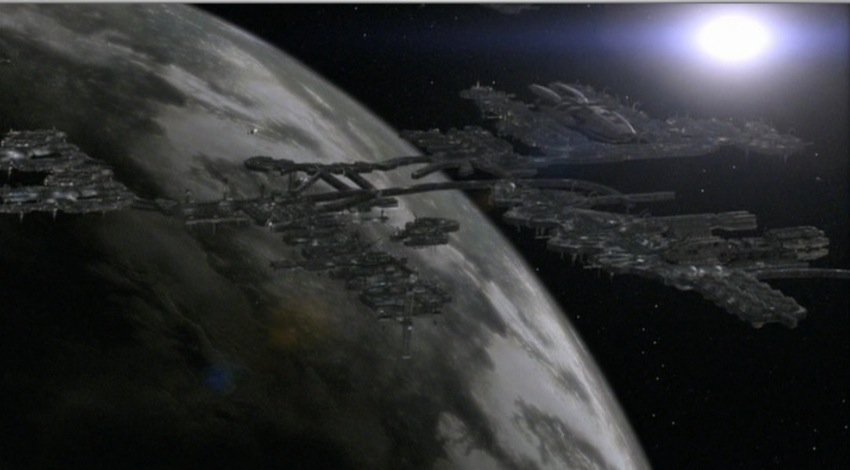
Once Scorpia gained her independence the facilities were quickly expanded and became a major deterrent to Leonese ambitions to recapture this Colony. After the signing of the Articles of Colonisation and the outbreak of the Cylon War, the shipyards were incorporated into the Colonial Fleet and became a major staging area for the Fleet. Attacked several times by the Cylons the Shipyards were either hidden inside moon fragments or sufficiently scattered that they could not easily be knocked out.
After the War many Colonial shipyards were closed and consolidated with others leading to Scorpia becoming one of the key bases. This decision was mostly economic and many in the Service protested that the Shipyards would be a prime target for Cylon attacks and could potentially cripple the Fleet if they were able to launch a surprise attack, but after many years of heated discussion Fleet Heaquarters asserted there would be sufficient time to respond to an attack and that the Shipyards would not require additional defences or special measures. Recently, an investigative reporter team from Leonis uncovered a possible corruption scandal involving Scorpia, but these allegations have so far been denied by the current administration. This new development puts further strain on the already unpopular Adar.
The Shipyards have been expanded and include the largest docks in the Colonies, capable of tending to the massive Titan Class Battlestars and other heavy ships. The Shipyards are protected by dozens of Viper squadrons and several Battlestars are on patrol duty at any time. About a third of the reserve fleet is also berthed in the Shipyards, maintained to standards of basic readiness, manned by skeleton crews. The Shipyards also manufacture new ships and several Mercury, Nova and Valhalla class Battlestars are currently being built. The Scorpia Shipyards have long prided themselves in having the best safety record among the Colonies and were able to rebuild the heavily damaged Battlestar Cyrannus in less than three days, just in time to participate in the Battle of Cosmora Archipelago where her Vipers destroyed two Basestars, though the Cylons were able to destroy the entire Fourth Fleet, with the exception of Admiral Kronus' flagship, Battlestar Rycon.
The shipyards are a boon to the Scorpian economy, but also have given rise to crime, prostitution and drug use in certain areas. Religious and political groups are putting pressure on the Scorpian government to put an end to this and keep Fleet personnel segregated in orbit without direct access to Scorpia proper.
Monday, May 31, 2010
Freedom Series
As the Cylon war grew in intensity the Colonial Fleet found itself fielding a mix of advanced Battlestars, supported by an ecclectic mix of older Colonial ships, many of them Pre-Battlestars such as Destroyers and Carriers. Many such ships were not designed to operate alongside Battlestars and the newer generation of ships, they proved to be problematic, slow and using different parts and supplies they became a logistical nightmare for the Colonial Fleet.
In an attempt to produce more capable vessels a number of ship classes were based on modified Battlestars. This had the advantage of offering new ships based on a proven hull and capable of operating with Battlestars and keep up the pace. A major drawback was that by sharing the same design, they often drained resources that might have been used to build more Battlestars.
In order to fix this problem, the Freedom class was proposed. Orignally designed as a modular vessel capable of operating alternatively in the role of a Gunstar, a Strikestar or even as a light Battlestar, the cost and complexity killed the modularity, but designers retained the main hull and built variant designs. Cheap and simple to build the Freedom Class soon became a familiar sight in Battlestar Groups. Many had one or more Freedoms operating under various roles.
Though versatile and easy to build the Freedom was not without weaknesses. The designs were spartan at best, built quickly and cheaply they were poorly armoured compared to Battlestars, despite attempts to use them as light Battlestars, they were vulnerable to concentrated attacks. The Gunstar variants proved equally vulnerable. It was as Strikestars and Skirmishstars that the Freedom came into its own. The CIWS "Flakstar" proved a very effective design and many light Battlestars ended up being used as Escortstars, another role in which they excelled.
Their limited build quality meant that most Freedoms were scrapped after the war. The better hulls were refurbished and a limited number still serve with the reserve. The pressures of the Cylon War abated, the Colonial Fleet did not prolong this practice and most post-war vessels were dedicated designs. Several attempts were made over the years to produce an updated version but with little success so far.
The Freedom also generated a very heated post-war debate, launched by a book written by the famous historian Casper Gamelyn, who contended that the Freedom class had proven itself to be superior and that Building more Battlestars was a critical mistake that kept the war going on for far too long. Though some of his points have been refuted by official sources over the years, the book "Fleets of the Ebon Sea, a concise history of the Cylon War" has a number of followers, notably politicians who have used the book to justify budget cuts and reforms, demanding that most Battlestars be scrapped in favour of a larger number of smaller vessels.
Freedom Series Vesta Class Light Battlestar
The Vesta was the first attempt to build a light Battlestar using a Freedom hull. The resulting design proved mediocre at best. Unlike the long flight pods of Battlestars, the Vesta had five landing bays perpendicular to the ship's axis, with the fighter launch tubes mounted directly underneath it had a faster recovery rate than many such designs, but their short length precluded the "swarm" landing the longer flight pods allowed, greatly increasing recovery times, leaving the poorly armed Vesta vulnerable to enemy attacks. With only four main gun turrets and a limited CIWS, the Vesta was not able to fight on the line as the Battlestars. After several losses they were retired from service and were used as Escortstars, a role they were much suited to.
Freedom Series Centaur Class Light Battlestar
The Centaur replaced the limited landing bays with a pair of large flight pods that could not only accept fighters, but a number of smaller vessels. A very effective design it suffered the same weakness as the Vesta. Poorly armed and armoured it wasn't a match for Cylon attacks and was used mostly as an Escortstar. A number were used to guard the Colonies and were involved in fighting off Cylon raids and invasions, but often paid the price in blood. Though often referred to as a Battlestar, and used as such on occassion, they officially were considered Escortstars.
Freedom Series Dragon Class Light Gunstar
Based on the successful Tiger Gunstar the Dragon carried a pair of foward batteries in addition to 4 KEW turrets. The long range of the forward batteries allowed them to harass Cylon Basestars, but their armour and defensive weaponry was inadequate to fight off the inevitable counter-attack. Later in the war a new jump in jump out tactic was developed, but the inaccuracy of jumps often meant a number of course adjustments to bring the main weaponry to bear on target, exposing the ship to attacks. Though successful on occasion, several Dragons accidentally jumped in the middle of a Cylon Basestar formation and were destroyed. The remaining ships were used as heavy escorts for supply convoys. Most were scrapped after the war or used for training purposes.
Freedom Series Drosera Class Skirmishstar
One of the most successful applications of the Freedoms was the "Flakstar". Mounting nearly 700 CIWS and three rapid fire KEW turrets the Drosera could lay down a formidable flak field and protect nearby vessels from attack. More Droseras were built than any other Freedom design and most Battlestar Groups had one or more in their lineup. A small number still serve with the reserve today.
Freedom Series Arachne Class Missilestar
Another succesful design the Arachne was a potent missile carrier. Able to stand off the enemy it used an unusual method of attacking Cylon ships. By firing a spread of unguided missiles at shorter ranges, it evaded Cylon jamming and hijacking. Using a similar method to the jump-in, jump-out method pioneered by the Dragon series it would jump in the middle of a Cylon formation, fire missiles in all directions and jump before attacked. While few Basestars were destroyed in such a manner it often broke Cylon formations, leaving them vulnerable to be picked out by Battlestars and Gunstars.
Freedom Series Baal Class Strikestar
Mounting ten heavy KEW turrets, a squadron of fighters and a heavy CIWS array, the Baal was a cramped, but powerful ship. Mounting an armament more suitable for a Gunstar, the Baal was used as an escort and patrol ship guarding the Colonies and outposts, freeing up more powerful ships for service on the Line. Relatively few Baals served in Battlestar Groups, most operating independently or in small groups.
Freedom Series Meleager Class Gunstar
Mounting a substantial arsenal the Meleager was not a very succesful design and few were produced. Many were used as escorts and on one occasion a single Meleager engaged a Cylon Basestar attacking a convoy. The Pausinias damaged the Battlestar forcing it to retreat, but was crippled in the exchange. With atmosphere venting and with failing engines the survivors brought her into the shipyard. Crews sent in to inspect the damage found an unexploded nuclear bomb which would have torn the ship apart if it had detonated.
Freedom Series Argos Class Tanker
Though originally designed as a warship the Freedom series produced a very effective tanker. Faster than other existing types it could operate alongside Battlestars and reduced refuelling time, leaving the Group less vulnerable to attack. The Argos class is credited for allowing the Colonial Fleet to operate deep into Cylon space and bring the fight to the enemy.
Freedom Series Scorpion Class Heavy Missilestar
The Scorpion class was built on the Arachne Class. Capable of firing the heaviest ordonance in the Colonial Arsenal the Scorpion was built for heavy assaults and planetary bombardment. Several were built in the anticipated attack of the Cylon homeworld and carried E class "planetbusters" with a yield of 200 megatons each. The Armistice meant they were never used, but two still remain in the reserve fleet and eight more have been mothballed should they ever be needed.
Subscribe to:
Posts (Atom)